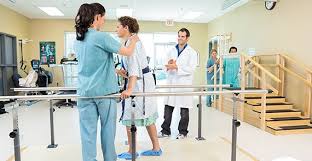
What is a stroke?
Today we are talking about stroke. In this article, you will learn about the problems that a person has face with stroke and Occupational therapy treatments for that problems

A stroke is a disease caused by a neurodegeneration in some part of the brain due to a blockage of the blood supply or a blood vessel that ruptures in one area of the brain.

But for most people, the word stroke is not a familiar term. Many people refer to this disease as paralysis.
🔴 Is stroke and paralysis the one ???
In fact, stroke and paralysis are two different conditions, but they are interrelated. For our understanding we can explain it like this.
★ A person's brain supply may be impaired, resulting in nerve death, which can be simply referred to as a stroke.
It is an interruption of the blood flow within your brain that causes the death of brain cells.
It is an interruption of the blood flow within your brain that causes the death of brain cells.
☆ As a result of the nerve dying, a paralysis/ disfunction of his body or body part can cause paralysis.
It is loss of motor function in muscles of our body or state of being unable to act or react.
In fact, stroke is a very dangerous disease. Because it can do you so much damage in such a short time.
Stroke causes these problems.....

✅ Problems of balance
✅ Difficulty in communication.
✅ Problems associated with memory
✅ Problems associated with appearing .
✅ Problems associated with oncology
✅ Issues related to human health
✅ And many other problems can be encountered.
✅ Issues related to human health
✅ And many other problems can be encountered.
(TIA) Trans Ischemic Attack
In this case, the symptoms of the stroke may show up in a short period of time.
It is advisable to seek treatment at this time as an indication that you may become seriously ill in the future.
How can we know if there is a stroke?
◾⭕ FAST ⭕◾
F ⇨ Face - pulling one of the facial muscles
A ⇨ Arm malfunction
S ⇨ Speech - speech is difficult
T ⇨ Time - If you see some of the above symptoms, you should go to the nearest hospital without wasting time.
Keep in mind, in addition to these features in general,
⭕ Weakness,
⭕ Fainting
⭕ One half of the body is down,
⭕ Impaired vision,
⭕ Severe headaches,
⭕ Thinking is lacking,
⭕ Swallowing may be impaired.
Emergency medical care is urgently needed. The longer the brain lacks oxygen, the more damage it causes.
Stroke is the most frequent cause of death after heart attacks, cancers, respiratory infections and accidents.
◾ You should go to the nearest hospital as soon as you see possible symptoms of stroke.
After a screening by a doctor, a vaccine is given only when appropriate.It reduces the risk of stroke complications.
Not every stroke patient deserves this,
The delay in transporting the patient to the hospital may further reduce the chance of receiving the vaccine.
The delay in transporting the patient to the hospital may further reduce the chance of receiving the vaccine.
Initial treatment and screening are done.
In order to find out the cause of the stroke and suppress them, the rehabilitation process will be initiated to minimize the disability caused by the stroke.
In order to find out the cause of the stroke and suppress them, the rehabilitation process will be initiated to minimize the disability caused by the stroke.
🔲 Physiotherapy is also used to reduce the loss of one side of the body and the hand and foot function.
🔲 Occupational therapy is done to minimize the risk of stroke, which is essential to everyday life, using hands and fingers, such as brushing teeth, dressing, eating ,toileting and writing.
#Occupational therapy for stroke🏥🏥
Occupational therapists help patients improve their sensory, cognitive and motor abilities during the post-stroke recovery period so patients can relearn valuable skills, including activities of daily living...
#Examples....
Bathing and Grooming.🚿
Dressing and Undressing.🙆
Meal Preparation and Feeding.🥘
Functional Transfers.⛸️
Safe Restroom Use and Maintaining Continence.
Ambulation.
Memory Care and Stimulation🎀
With these skills, stroke survivors can return to normal life...😊😊

🔲 Treatment of speech-language pathology is also started to reduce swallowing difficulties, language comprehension, speech, pronunciation, word recall difficulties, writing and reading difficulties.
In addition, at major hospitals around the country, which have dedicated wards for stroke treatment,
Social Services Support,
Just like psychological counseling
The family also provides advice on how to take care of a stroke patient.
Social Services Support,
Just like psychological counseling
The family also provides advice on how to take care of a stroke patient.
..........................................................
A stroke patient may have several vision problems ...
🧐🧐🧐🧐🧐🧐🧐🧐🧐🧐🧐🧐
01. Diplopia
Here the patient may see the same image or object as two images.
For some, it can be seen as two images of the same image, very clearly separated.
For some it may look like an original image and a leaked image, for others it may look like a small blur.
This varies from patient to patient depending on the severity of the disorder.
For some, it can be seen as two images of the same image, very clearly separated.
For some it may look like an original image and a leaked image, for others it may look like a small blur.
This varies from patient to patient depending on the severity of the disorder.
In this case,
👁️the patient is unable to hold an object at once.
👁️Inability to read newspapers
👁️It can be difficult to read time on the clock.
👁️the patient is unable to hold an object at once.
👁️Inability to read newspapers
👁️It can be difficult to read time on the clock.
🧐🧐🧐🧐🧐🧐🧐🧐🧐🧐🧐🧐🧐
02.Hemianopia
The patient appears to be only half of his normal range of symptoms. He can't see the other half.
👁️this type of Patients are walking on one side always collide with barriers.
👁️Responding only to one side of the crowd.
👁️ When using a table, use only one side.
👁️On one side of the eatery, there are signs such as leaving food.
👁️Responding only to one side of the crowd.
👁️ When using a table, use only one side.
👁️On one side of the eatery, there are signs such as leaving food.
🧐🧐🧐🧐🧐🧐🧐🧐🧐🧐🧐🧐🧐
03. Blurred vision
(Blurred vision.)
In this case, the patient's appearance is always in the form of a bodice. This may be just blurry or bulky. It varies from patient to patient.
👁️These people have difficulty reading newspapers and books.
👁️ Symptoms such as difficulty identifying people.
👁️ Symptoms such as difficulty identifying people.
🧐🧐🧐🧐🧐🧐🧐🧐🧐🧐🧐🧐🧐🧐
04.Visual Intention
Visual insufficiency is a common condition associated with stroke. 'Also known as unilateral spatial neglect, this can be described as a difficulty in finding or acting on one side of the space.
👁️ In this case the patient is seen to be ignoring one side of the space.
👁️ He has always been one-sided in his dealings with the external environment and with people...
👁️ He has always been one-sided in his dealings with the external environment and with people...
In addition to these four problems, a patient may have so many other vision problems.)
…………………………………………….................
😎😎😎😎😎😎😎😎😎😎😎😎
…………………………………………….................
😎😎😎😎😎😎😎😎😎😎😎😎
There are a number of therapeutic treatments for the above-mentioned vision problems...

💥 Accurate detection of the above symptoms through proper testing methods
💥 Evaluate its impact on day-to-day activities through regular testing methods.
💥 Minimizing symptoms through treatment activities. (Theraputic activities)
💥 Environmental modification
💥 Adaptation
💥 New skills and method training
And other specialized occupational therapeutic methods are used.
💥 Evaluate its impact on day-to-day activities through regular testing methods.
💥 Minimizing symptoms through treatment activities. (Theraputic activities)
💥 Environmental modification
💥 Adaptation
💥 New skills and method training
And other specialized occupational therapeutic methods are used.
Identifying and correcting these vision problems in the treatment of stroke, especially in rehabilitation, can have a major impact on the success of the overall rehabilitation process.
It restores the patient's lost skills and abilities and allows him to carry out his day-to-day activities independently.
It should be directed towards the treatment and rehabilitation process as well as preventing the onset of stroke.
❌Stop smoking
❌Reduce using alcohol
❌Quit using drugs
❌Quit using fast food and beverages
❌Do daily exercises and maintain your body weight
❌Reduce salt intake
⭕Diabetes and high blood pressure are important to manage.